Industrial felt components · wholesale enquiries
Custom Felt Washers & Felt Rings
A felt washer is a ring-shaped felt component defined by outside diameter, inside diameter and thickness. Buyers consider felt rings for cushioning, spacing, lubricant retention or dust-contact functions, with suitability dependent on the selected material and assembly. Send your drawing or replacement dimensions to Cornovo for a quotation review.
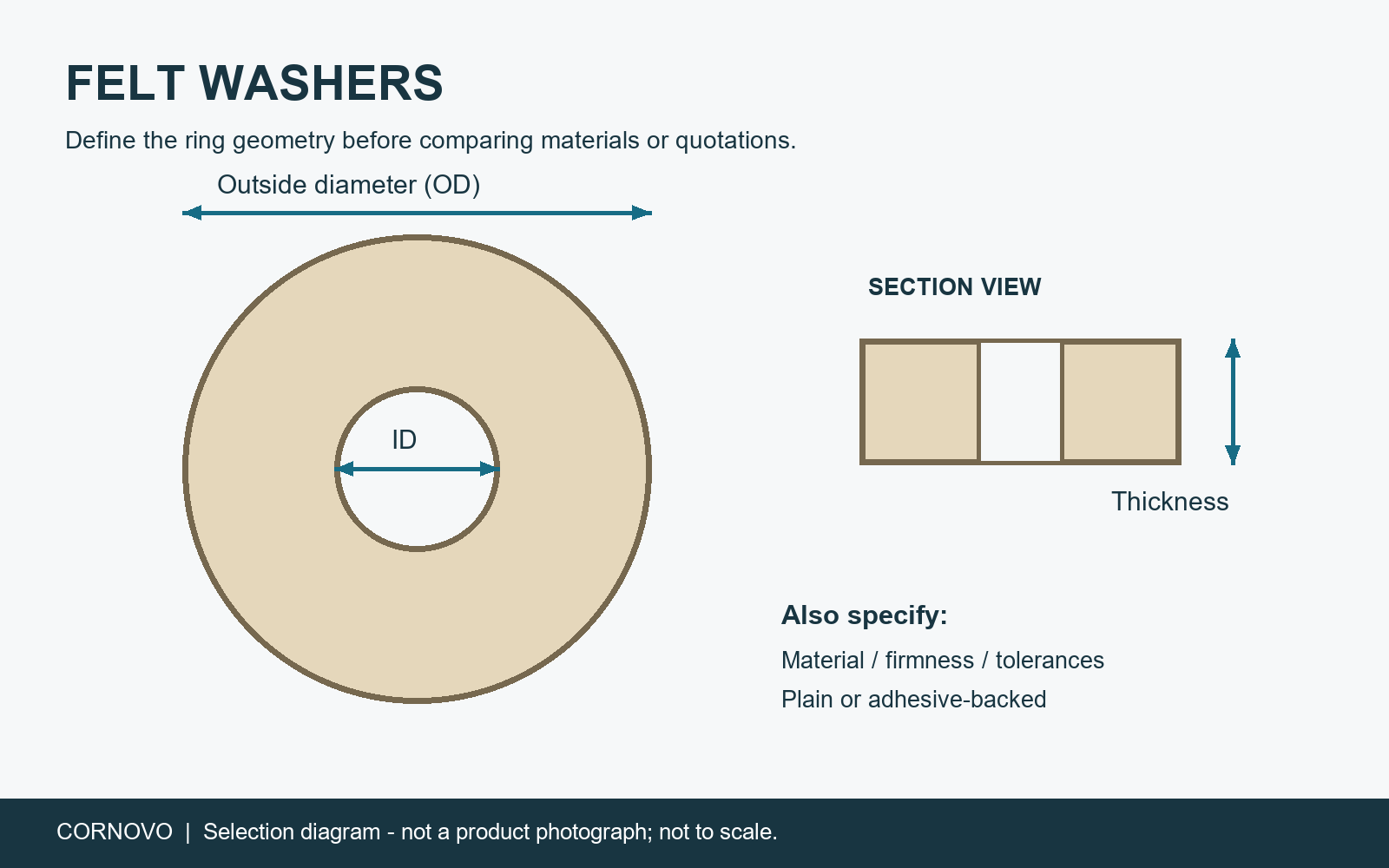
Three dimensions identify the ring
Record outside diameter (OD), inside diameter (ID) and thickness (T), using one unit system. The hole must be smaller than the outside diameter, but that alone does not establish fit. Include any recess, shaft clearance or compression requirement from the assembly drawing. If the hole is off-centre, slotted or another shape, provide a drawing instead of describing the part as a standard washer.
A felt washer is different from a polishing wheel
A ring-shaped felt component may resemble a small wheel in a photograph. Its name does not establish that it can be fitted to a rotating tool. For a polishing-wheel enquiry, specify the working face, mounting and approved operating information and use the relevant wheel page. For a washer or felt ring, begin with the role it performs inside the assembly.
Choose material for the actual function
Wool felt and synthetic felt appear in industrial component catalogues, but their grades should not be treated as interchangeable. Identify the requested fibre composition, density or firmness and any existing material reference. Where the part contacts lubricant, paint, a finished surface or another material, include that information for review. A colour description cannot establish a material grade, chemical compatibility or certification.
Specification checklist for your quotation
| Selection item | What to specify |
|---|---|
| Ring geometry | Outside diameter × inside diameter × thickness; include units and tolerances. |
| Cut profile | Round ring, offset hole, slot, split or another drawing-defined shape. |
| Material / grade | Requested composition, density or firmness and existing material designation. |
| Adhesive request | Plain, one-sided or another requested construction; confirm adhesive, liner and mating surface. |
| Assembly conditions | Contact surfaces, compression, movement, lubricant and relevant environmental requirements. |
| Acceptance criteria | Dimensional method, edge condition, fit and functional sample checks. |
| Packaging | Pieces per pack and carton, identification, clean handling and any orientation requirements. |
This is an enquiry range. No universal size, material percentage, operating rating, stock availability or fixed MOQ is implied. Confirm the exact item in the written quotation.
Application scenarios and sample checks
Use the intended application to define the sample trial. The examples below are selection discussions, not blanket performance approvals.
| Enquiry | Information to provide | What the trial should check |
|---|---|---|
| Cushioning or spacing | Assembly gap, contact surfaces and the acceptable compressed condition. | Inspect fit and contact without assuming a rigid metal-washer function. |
| Lubricant-retention enquiry | Lubricant, existing part, contact geometry and required service conditions. | Confirm the material and functional behaviour on an approved assembly sample. |
| Dust-contact component | Movement, clearance, compression and the required exclusion function. | Evaluate the proposed part in the actual equipment; do not infer a pressure rating. |
Plain and adhesive-backed requests must stay separate
An adhesive-backed washer has additional selection requirements: the mating surface, adhesive type, application conditions, liner and storage instructions. State which face should carry adhesive and whether parts are needed individually or on a carrier. If your drawing calls for plain felt, do not treat an adhesive-backed alternative as an automatic replacement. Packaging and the quotation should identify the complete construction.
Custom cutting starts with a controlled drawing
Include the part number, drawing revision, units and critical dimensions. A reference sample is useful when a drawing is unavailable, but tell us whether it is new, compressed or worn. Confirm any tooling or development charge separately from the piece price. Different ring sizes, materials and adhesive constructions should have separate order lines so the quotation remains comparable.
What to check before a repeat order
Inspect OD, ID, thickness, edge condition and the position of the hole against the approved method. Check material and pack identification, then assess the part in the intended assembly. Retain the accepted specification and sample reference. Changes to felt grade, adhesive, thickness or cutting profile should be reviewed as changes, even when the outside diameter stays the same.
Frequently asked purchasing questions
How do I specify a felt washer size?
Give OD × ID × thickness in millimetres or inches, with tolerances where required. Add a drawing for slots, split rings, offsets or other special geometry.
Can a felt ring replace a rubber gasket or metal washer?
Not on appearance alone. These components can have different mechanical and sealing functions. Review the assembly requirements and approve the proposed material and geometry before substitution.
Are all felt washers made from 100% wool?
No universal composition is established by the product name. State the required fibre content or material designation and request confirmation for the quoted item.
Can I enquire about self-adhesive felt washers?
Yes. Specify the adhesive face, mating surface, application requirements, release liner and pack format. The available construction and commercial terms need confirmation.
Do you provide a fixed pressure or temperature rating?
No universal rating is published for this enquiry range. Any required service rating must be supported by the selected material and component information for the actual application.
What are the MOQ and sample costs?
Request them for the defined ring size, material, cutting requirements, quantity and packaging. Any tooling, sample, packing and delivery charges should be separated in the written quotation.
Send an enquiry that can become a clear purchase order
Send the drawing or reference sample, material requirements, quantities by variant and destination. Ask the quotation to confirm the sample specification, order unit, MOQ, unit price and currency, quotation validity, packing, lead time and delivery basis. Separate any tooling, sample, adhesive, packaging and freight charges so you can compare the complete proposed supply.
Before confirming repeat production, retain the accepted sample, drawing revision and written inspection requirements. Include the delivery destination and any label or barcode requirements.
Send dimensions and request a quote
Email: sales@cornovoabrasive.com · WhatsApp +86 186 1817 1069
Compare related felt formats
ORDER PLANNING
Wholesale Order & Carton Calculator
Estimate goods value, carton count and packed volume using your own quoted price and confirmed packing data. For sets or rolls, use the same order unit for quantity, price and units per carton.
Cartons = quantity ÷ units per carton, rounded up. Goods value = quantity × unit price. Volume = cartons × outer length × width × height ÷ 1,000,000 (cm to m³). The final partial carton uses the same outer dimensions. This is an estimate, not a quotation or customs calculation.
Enable JavaScript to use the calculator, or send your quantity and carton information with your inquiry.